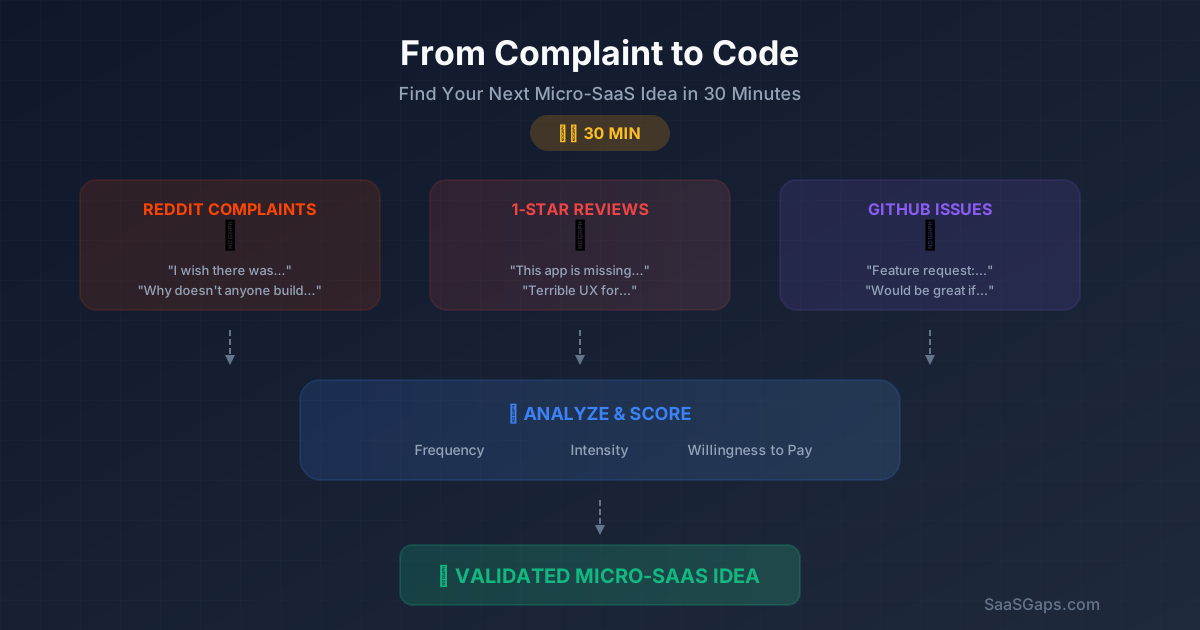
From Complaint to Code: How to Find Your Next Micro-SaaS Idea in 30 Minutes
Stop brainstorming in a vacuum. Learn the practical 30-minute framework for mining Reddit complaints, 1-star app reviews, and GitHub issues to discover validated micro-SaaS ideas.
Forget brainstorming. The best product ideas aren't invented in conference rooms or shower thoughts. They're discovered by paying attention to what people are already complaining about, publicly, every single day.
I used to waste weeks "ideating." Filling whiteboards with concepts nobody wanted. Building features I thought were clever. The results were predictable—products that launched to silence.
Then I discovered something that changed everything. The validation data I needed was already out there, waiting to be mined. Reddit threads full of frustrated users. App Store reviews dripping with complaints. GitHub issues begging for solutions. All I had to do was look.

This article walks you through the exact process I now use to find validated SaaS ideas in 30 minutes flat. Not vague concepts—specific problems with clear signals that people will pay to solve.
Why Complaints Are Better Than Ideas
Here's something counterintuitive: a complaint is more valuable than an idea. Ideas are guesses about what might be useful. Complaints are proof that something is broken.
When someone writes "I wish there was an app that..." on Reddit, they're not brainstorming. They're expressing genuine frustration with their current situation. That frustration is your signal. It means there's a gap between what exists and what they need.
The same applies to 1-star app reviews. Nobody leaves a detailed negative review unless they actually cared about the product working. They tried it, it failed them, and they took time to explain why. That explanation is a product spec in disguise.
GitHub issues are even more direct. Developers don't file feature requests casually. They encounter a limitation, search for solutions, find none, and then document exactly what they need. The work of articulating the problem is already done for you.
The traditional approach—sitting around thinking about what might be useful—skips all this signal. You end up building solutions in search of problems. The complaint-first approach inverts this. You start with validated problems and work backward to solutions.
The Three Goldmines of Validated Pain
Before diving into the 30-minute process, let's understand where the best complaints live. Not all sources are equal. Some produce noise. Others produce signal.

Reddit remains the most valuable source for most founders. The platform's structure encourages detailed, honest expression. Subreddits create concentrated communities around specific topics—small business owners, freelancers, marketers, developers. These people discuss their tools openly, including what's broken about them.
The key subreddits vary by market. For B2B SaaS, r/SaaS, r/startups, r/Entrepreneur, and r/smallbusiness consistently produce high-quality complaints. For consumer apps, niche hobby subreddits often reveal opportunities that generic product communities miss. A complaint in r/photography about editing workflows is more actionable than a generic "what should I build" thread in r/startups.
One-star app reviews are underutilized goldmines. Most founders obsess over 5-star reviews for validation. But 1-star reviews tell you exactly what competitors are doing wrong. They reveal the features people expected but didn't get, the workflows that break down, the frustrations that cause churn.
The App Store and Google Play are obvious starting points. G2, Capterra, and TrustRadius cover B2B software with detailed, professional reviews. Product Hunt comments often contain early user feedback on newly launched products—complaints that the founders haven't addressed yet.
GitHub issues work best for developer tools and technical products. The label system helps filter signal from noise. Look for "enhancement," "feature-request," and "help-wanted" tags. Issues with many thumbs-up reactions indicate widespread demand. Closed issues marked "wontfix" reveal gaps that maintainers have explicitly chosen not to address—opportunities for new products.
The 30-Minute Framework
Enough theory. Here's the exact process I use to surface validated ideas quickly. The goal isn't comprehensive research—it's rapid pattern recognition. You want to identify 3-5 promising opportunities that warrant deeper investigation.
The process breaks into three 10-minute phases: Mine, Filter, and Validate.
Phase 1: Mine (Minutes 0-10)
The first phase is pure collection. You're scanning sources quickly, grabbing anything that looks like a complaint worth noting. Don't evaluate yet—just capture.
Start with Reddit. Open 2-3 relevant subreddits in tabs. Use the search function with complaint-oriented phrases. The classics work well: "I wish there was," "why doesn't anyone build," "frustrated with," "hate when," "looking for alternative to." Set the sort to "Top" for the past month to catch recent, validated complaints.
Scan quickly. You're looking for posts with engagement—upvotes and comments indicate others share the frustration. Copy the post title and URL into a simple document. Don't read deeply yet. Aim for 8-10 potential complaints in 3-4 minutes.
Switch to app reviews. Pick 2-3 established products in a space you're interested in. Go straight to the 1-star and 2-star reviews. Read the detailed ones—short "this sucks" reviews are useless, but multi-paragraph complaints contain specific feature requests and workflow breakdowns. Note the patterns. If multiple reviews mention the same missing feature, that's signal.
Finally, hit GitHub if you're targeting developers. Search for issues with high reaction counts in popular repositories. The "enhancement" label is your friend. Look for issues that have been open for months with active discussion—these are problems the maintainers haven't prioritized but users clearly want solved.
By minute 10, you should have a raw list of 15-25 potential complaints across all three sources.
Phase 2: Filter (Minutes 10-20)
Now you evaluate. The goal is to reduce your list to 3-5 serious candidates using a quick scoring system.
For each complaint, ask four questions.
First, frequency: Is this a one-off gripe or a pattern? Search for variations of the same complaint. If you found it once, others probably mentioned it too. Multiple occurrences across different threads, reviews, or issues significantly increase the score.
Second, intensity: How frustrated are they? Mild annoyance scores low. "I've been struggling with this for months" scores high. Emotional language—caps, exclamation points, detailed rants—indicates deeper pain. The more frustrated they are, the more likely they'll pay for relief.
Third, willingness to pay: Are they asking for a product or just venting? Look for explicit signals like "I'd pay for this" or "worth any price." Also check if they're currently paying for inadequate alternatives. Someone already spending $50/month on a tool they hate will happily switch to something better.
Fourth, solvability: Can software actually fix this? Some complaints are about fundamental issues no product can address. Others have clear technical solutions. Prioritize problems where you can imagine the feature set within an hour of thinking.
Score each dimension mentally—high, medium, or low. Complaints that score high on at least three dimensions make the cut. By minute 20, you should have 3-5 strong candidates.
Phase 3: Validate (Minutes 20-30)
The final phase adds context to your top candidates. You're checking if the opportunity is real and unclaimed.
For each remaining idea, do a quick competition check. Search Product Hunt, Google, and app stores for existing solutions. Finding competitors isn't necessarily bad—it validates the market exists. But finding a dominant, well-funded incumbent suggests the opportunity may be harder to capture.
Estimate market size roughly. How many people have this problem? Are they businesses (higher willingness to pay) or consumers (harder to monetize)? You don't need precise numbers—just a gut check that the market isn't too small.
Finally, note your top pick. Write a one-sentence problem statement: "[Audience] struggles with [problem] because [reason], and current solutions fail by [gap]." This crystallizes your thinking and gives you something concrete to research further.
By minute 30, you should have a clear top candidate and 2-4 backups, all grounded in real user complaints rather than speculation.
Real Examples from the Wild
Let me show you how this plays out with actual complaints I've encountered.
A recurring theme on r/SaaS involves founders struggling to manage Reddit presence authentically. The complaint appears in various forms: "How do I monitor relevant conversations across 20 subreddits without it becoming a full-time job?" and "I want to engage genuinely but can't track everything."
Frequency: high—I found variations in multiple threads. Intensity: medium—frustrating but not hair-on-fire urgent. Willingness to pay: high—several mentioned using paid monitoring tools that don't work well for Reddit specifically. Solvability: very high—this is a clear software problem.
This maps to a real opportunity. Multiple Reddit monitoring and engagement tools have since launched targeting exactly this use case.
Another pattern emerged from 1-star reviews of project management tools. Users repeatedly complained about "too many features" and "takes forever to set up." They wanted something simpler—not another Notion or Monday with 50 integrations, but a lightweight tool for small teams who just need the basics.
This complaint spawned multiple successful "anti-feature" project management tools. Linear leaned into simplicity. Basecamp doubled down on their opinionated, streamlined approach. The market validated that complexity itself was a problem worth solving.
GitHub issues for popular API clients frequently request better error handling and debugging features. Developers complain that when API calls fail, they get cryptic errors that take hours to diagnose. The maintainers of these libraries often mark such issues as "wontfix"—they're focused on the core functionality, not developer experience around edge cases.
This created an opportunity for API debugging and monitoring tools. Products like Postman, Insomnia, and various API testing services all address pain points that emerged from complaints in GitHub issues and developer forums.
From Complaint to Code
Finding a validated complaint is the beginning, not the end. The complaint tells you what to build. You still need to figure out how.
Start by going deeper on your top candidate. Read every comment on the original complaint thread. Often the most useful information is buried in replies where people elaborate on their specific situations. Note the exact language they use—this becomes your marketing copy later.
Reach out directly if possible. Reddit allows DMs. Many people who complained publicly are willing to spend 15 minutes describing their problem in more detail. You're not selling anything yet—just listening. This qualitative research shapes the product in ways aggregate data cannot.
Build the smallest possible version. Your first release shouldn't solve the entire problem. It should solve one narrow slice well enough that people will use it and pay for it. A Chrome extension beats a full platform. A spreadsheet template beats a SaaS product. Validate the core value before investing in infrastructure.
Launch back into the communities where you found the complaint. Reddit hates obvious self-promotion but responds well to genuine problem-solving. If you built something because of complaints in a specific thread, posting "I built this because of your feedback" tends to get positive reception. Just be transparent and actually helpful.
The Compound Effect of Systematic Mining
The 30-minute process isn't a one-time event. It's a practice. The founders who consistently find winning ideas don't do it through occasional brilliance—they do it through regular attention to what users are saying.
Set aside time weekly to run through this process. Your pattern recognition improves with repetition. You start noticing connections across sources. A complaint on Reddit matches a GitHub issue matches a 1-star review. That convergence is powerful signal.
Keep a running list of validated opportunities. Not every complaint you find will be right for you right now. But markets shift. Your skills evolve. An opportunity that doesn't fit today might be perfect in six months.
The best indie hackers I know treat complaint mining as a core competency. They're always listening, always noting patterns, always ready to pounce when the right opportunity emerges.
Skip the Manual Work
Everything I've described works. It's also time-consuming once you go beyond the initial 30-minute scan. Deep research on multiple opportunities, tracking complaints over time, scoring and prioritizing systematically—this becomes hours per week of work.
That's exactly why we built SaaSGaps. We automate the entire complaint-mining process. Our AI continuously scans Reddit, app reviews, GitHub issues, and dozens of other sources. It identifies pain points, scores them using frameworks like the one described above, and surfaces the highest-potential opportunities.
Every week, we deliver curated SaaS ideas directly to your inbox. Each comes with the original complaints, validation scores, competitive landscape analysis, and suggested approaches. You get the output of systematic research without spending the time yourself.
Get validated ideas delivered weekly →
Whether you use our service or run the 30-minute process yourself, the principle remains: stop inventing problems. The best SaaS ideas are already documented in the complaints of frustrated users. Your job is to find them and build solutions.
The next great micro-SaaS isn't hiding in your imagination. It's hiding in plain sight, in the complaints people are posting right now.
Want a steady stream of validated SaaS ideas without the manual research? Subscribe to SaaSGaps and join thousands of founders who've stopped guessing and started building products people actually want.
Author

Categories
More Posts
Tutorial: How to Migrate Your Spotify Playlists to Apple Music, Tidal, or YouTube Music
Ditching Spotify? Learn how to transfer your music library and playlists to Apple Music, Tidal, or YouTube Music using the best migration tools in 2025.
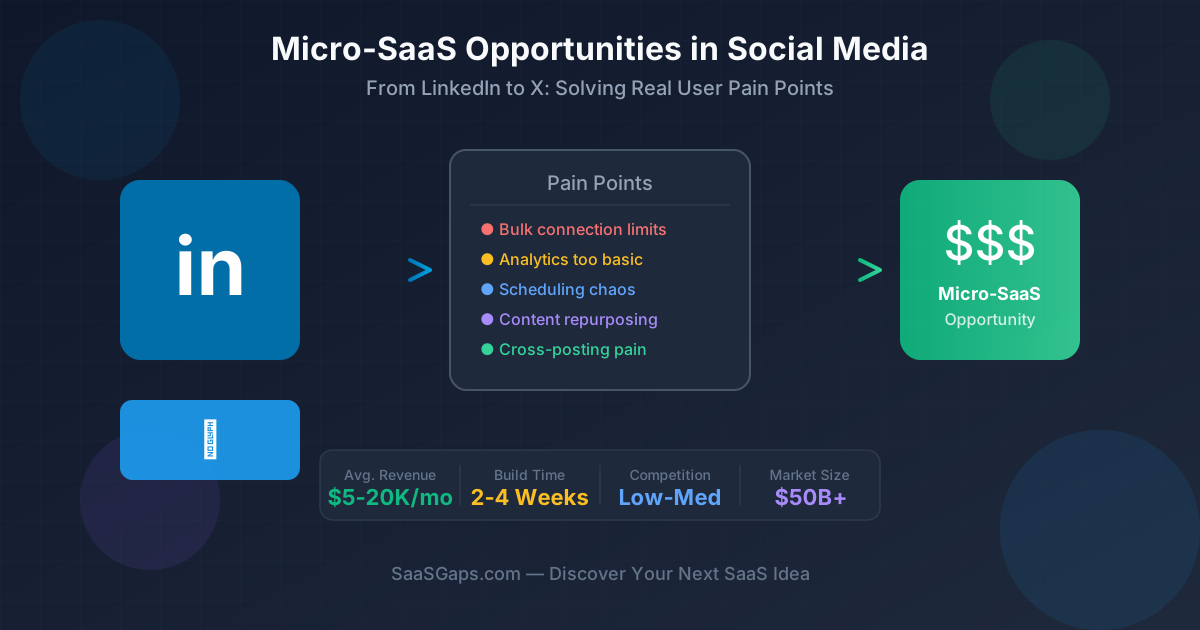
Micro-SaaS Opportunities in Social Media: Solving Pain Points from LinkedIn to X
Real user complaints across LinkedIn and X (Twitter): connection limits, InMail tracking, thread writing, analytics, and bookmark chaos—plus micro-SaaS MVP ideas.
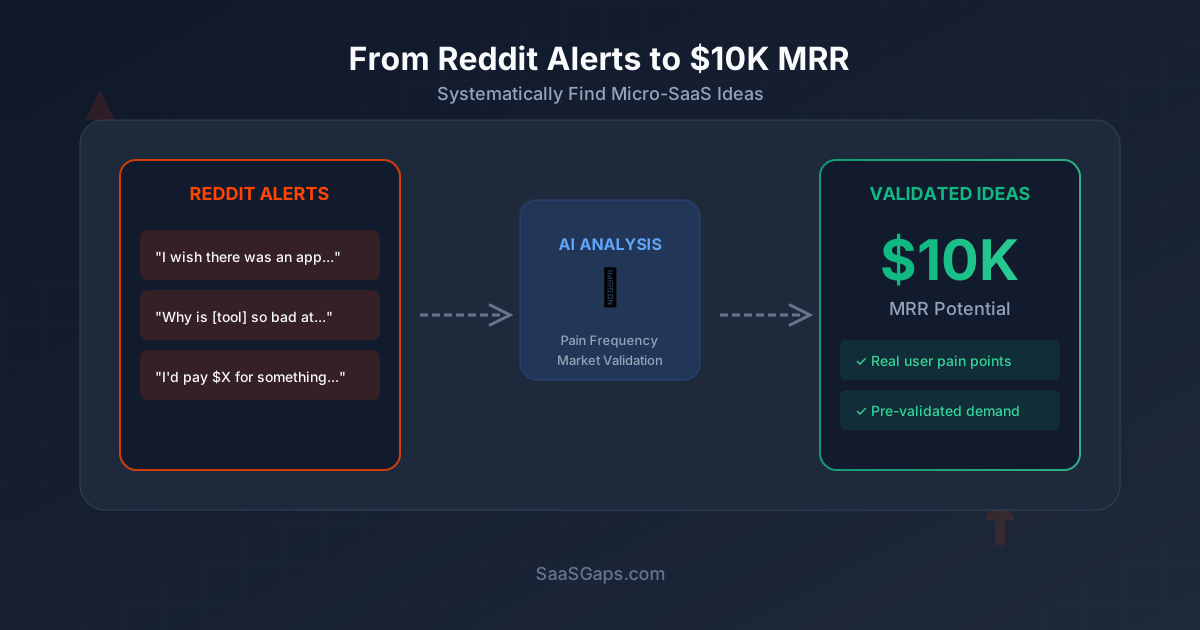
Reddit Alerts: Set Up Keyword Alerts to Find Micro-SaaS Ideas
Set up Reddit keyword alerts (F5Bot/RSS), track "I wish there was an app that..." posts, and turn recurring pain points into validated micro-SaaS ideas.
Newsletter
Join the community
Subscribe to our newsletter for the latest news and updates