
Idea Mining: The Systematic Approach to Discovering SaaS Opportunities Hidden in Plain Sight
Learn how successful founders systematically discover validated SaaS ideas by mining community discussions, support tickets, and forums for recurring complaints and unmet needs. A complete guide to idea mining methodology.
The best SaaS ideas don't come from sudden inspiration in the shower. They don't emerge from brainstorming sessions or trend reports. They're discovered through a systematic process that most founders completely overlook-a process I call idea mining.
Idea mining is the practice of analyzing community discussions, support tickets, reviews, and forums to identify recurring complaints, wishes, and unmet needs. It's the difference between guessing what people might want and knowing what they're already asking for. And in an era where AI and no-code tools have dramatically lowered the barrier to building software, this skill has become the true competitive advantage.
Think about it. Anyone can build an app now. The hard part isn't coding anymore-it's knowing what to build. The founders who consistently launch successful products aren't necessarily better developers. They're better listeners. They've mastered the art of extracting signal from the noise of online conversations.
I spent months studying how successful indie hackers and micro-SaaS founders find their ideas. The pattern became clear. They weren't sitting around waiting for inspiration. They were systematically monitoring specific channels, looking for specific signals, and validating opportunities before writing a single line of code. This article shares everything I learned about their approach.

The Shift from Invention to Discovery
There's a fundamental mindset shift that separates successful founders from those who struggle. It's the shift from trying to invent something new to discovering what's already needed.
The invention mindset sounds appealing. You imagine yourself as a visionary, creating something the world has never seen. But this approach is statistically terrible. Most "inventions" solve problems nobody has. They're solutions in search of problems, and they fail quietly after burning through months or years of effort.
The discovery mindset is different. You accept that good ideas already exist-they're just waiting to be found. Somewhere right now, someone is posting on Reddit about a frustration they have with their current tools. Someone is leaving a 1-star review explaining exactly what feature they needed but didn't get. Someone is asking in a forum if anyone else has solved a problem they're facing. Your job isn't to invent new problems. It's to find these existing complaints and build solutions for them.
This shift feels less glamorous at first. You're not the lone genius with the breakthrough idea. You're a detective, piecing together clues from scattered conversations. But the results speak for themselves. Ideas discovered through systematic mining have built-in validation. You know people want them because they've already said so, publicly, in their own words.
Creators who document micro-SaaS work often show how they can surface dozens of ideas in a week by systematically scanning Reddit, Twitter, and niche forums. Not by thinking hard. By looking carefully. The ideas are all there - you just have to recognize them.
Where the Signals Hide
Not all online conversations are equally valuable for idea mining. Some platforms produce mostly noise. Others are goldmines of actionable signal. Understanding where to look is half the battle.
Reddit remains the most valuable source for most founders. The platform's structure creates concentrated communities around specific topics. Subreddits like r/SaaS, r/startups, r/Entrepreneur, and r/smallbusiness host thousands of people discussing their tools, workflows, and frustrations daily. The voting system surfaces the most resonant complaints. The comment threads add context and nuance that you'd never get from surveys or interviews.
What makes Reddit special is the honesty. People aren't performing for an audience or trying to sell anything. They're venting genuine frustrations to a community of peers. When someone writes "I've been looking for a tool that does X and nothing works properly," that's not a hypothetical-it's lived experience. When a post about a specific pain point gets hundreds of upvotes and dozens of "same here" comments, you're looking at validated demand.
Twitter (now X) offers different but complementary value. The real-time nature captures emerging frustrations before they become widespread. Indie hackers often share their building journeys, including the problems they're trying to solve. Following hashtags like #buildinpublic, #indiehackers, or #microsaas surfaces a constant stream of problem-solution discussions. The quote tweets and replies often contain even more valuable insights than the original posts.
Indie Hackers deserves special attention for anyone building B2B or developer-focused tools. The community is dense with people who are both potential customers and potential competitors. The discussions are more substantive than typical social media-people share revenue numbers, explain their validation processes, and debate specific approaches. A complaint that surfaces on Indie Hackers often represents a problem that many technically-savvy users face.
GitHub issues are underutilized goldmines for developer tool opportunities. When someone takes the time to file a detailed issue on an open-source project, they're doing your market research for you. They've identified a specific gap, explained their use case, and often suggested potential solutions. Issues marked as "enhancement" or "feature-request" are particularly valuable. Those with many thumbs-up reactions indicate widespread demand. Issues closed with "wontfix" reveal gaps that maintainers have explicitly chosen not to address-opportunities for new products.
App store reviews follow a similar pattern. The 1-star and 2-star reviews of existing products contain product specifications disguised as complaints. People don't write detailed negative reviews unless they genuinely cared about the product working. They tried it, it failed them, and they explained exactly why. That explanation tells you what to build differently.
Product Hunt comments capture early feedback on newly launched products. When something launches and the comments section fills with "this is great but I wish it did X," you're seeing real-time feature requests. These are people who are already interested in the category-they're easier to convert than cold audiences.
The key insight is that each platform reveals different angles of the same underlying problems. Reddit shows breadth-how many people share a frustration. Twitter shows velocity-how quickly a problem is becoming pressing. GitHub shows depth-the technical specifics of what's needed. App reviews show gaps-what existing solutions fail to deliver. Combining signals across platforms creates high-confidence opportunity identification.
The Signals Worth Chasing
Within these platforms, not every complaint deserves attention. Some are one-off gripes. Some are impossible to solve with software. Some represent tiny markets. Learning to recognize high-value signals separates effective idea mining from aimless scrolling.

The most valuable signal is the explicit wish. When someone writes "I wish there was an app that..." they're handing you a product specification. These statements cut through ambiguity. The person has already imagined what they want-they just can't find it. Search for phrases like "I wish," "why doesn't anyone build," "someone should make," and "looking for a tool that." Each hit is a potential opportunity.
Frustrated rants are the second most valuable signal. Emotional language-caps, exclamation points, detailed explanations of what went wrong-indicates deep pain. Someone mildly annoyed won't spend ten minutes writing a Reddit post. Someone genuinely frustrated will. That frustration translates into willingness to pay for relief. The more emotional the complaint, the more valuable the signal.
Workaround sharing is a subtle but powerful indicator. When people describe the manual processes or hacky solutions they've cobbled together to solve a problem, they're revealing an automation opportunity. "I've been using a combination of Zapier, Google Sheets, and three browser extensions to..." means there's room for a purpose-built tool. The more convoluted the workaround, the more valuable the simplification.
Alternative seeking confirms market existence while revealing gaps. When someone asks "what's a good alternative to X?" they're validating that the category has demand while potentially revealing that existing solutions are lacking. The replies often explain exactly what's wrong with current options. This gives you a competitive strategy, not just an idea.
Feature requests in forums and issue trackers are product specifications from real users. They've thought through what they need and articulated it. The work of problem definition is already done. Your job is to build what they've described, possibly as a standalone product if the parent project won't address it.
Pricing complaints reveal opportunities for cost-based disruption. When users complain that tools are "too expensive" or wish there was a cheaper option, they're telling you that demand exists at a lower price point. This is especially actionable when enterprise-priced tools are being used by individuals or small teams who don't need all the features.
The most powerful signals combine multiple indicators. Someone frustrated with current tools, sharing a hacky workaround, and asking for alternatives? That's not one signal-that's a convergence of validation. Stack the signals for higher confidence.
The Mining Process in Practice
Understanding what to look for is one thing. Executing systematically is another. Let me walk you through the process I use to surface validated ideas efficiently.
The first phase is monitoring setup. You need to establish persistent surveillance of your target channels. This doesn't mean checking Reddit once a week. It means setting up saved searches, RSS feeds, and alerts that notify you when relevant conversations happen. I use a combination of Reddit's saved search feature, Twitter lists, Google Alerts for specific phrases, and dedicated tools that aggregate forum discussions.
The goal is passive collection. You want signals flowing to you continuously, not requiring active hunting. Set up alerts for your target phrases across your target subreddits. Follow relevant hashtags and accounts on Twitter. Subscribe to newsletters that curate community discussions. The setup takes a few hours, but once running, opportunities come to you.
The second phase is pattern recognition. Raw signals are just noise until you spot patterns. A single complaint about email marketing tools could be a fluke. The same complaint appearing across three subreddits, two Twitter threads, and multiple app reviews? That's a pattern. I maintain a simple spreadsheet where I log promising signals with their source, date, and a brief summary. Over time, clusters emerge. Similar complaints from different sources about the same category indicate real opportunity.
The third phase is depth research. When a pattern emerges, I go deep. I read every comment on the original threads. I search for variations of the same complaint to understand its dimensions. I look at what existing solutions people have tried and why they failed. I estimate market size by looking at subreddit subscriber counts, search volumes, and competitor user bases. The goal is to move from "people are complaining about X" to "here's exactly what they need, why current solutions fail, and how big the opportunity is."
The fourth phase is validation design. Before building anything, I design a minimal validation. This might be a landing page explaining the proposed solution to see if people sign up for updates. It might be a direct message to someone who complained, asking if they'd pay for a solution. It might be a simple prototype or mockup to gauge reactions. The goal is to get a signal that the opportunity is real and that my proposed solution resonates before investing significant time.
This process runs continuously. I'm always monitoring, always pattern-matching, always going deep on promising clusters. Some weeks produce nothing interesting. Other weeks surface multiple high-potential opportunities. The key is consistency-idea mining is a practice, not an event.
The Validation Matrix
Not every discovered opportunity deserves pursuit. Some are too small. Some are too competitive. Some are outside your capabilities. A systematic scoring approach prevents wasted effort on low-potential ideas.

I evaluate opportunities on two primary dimensions: frequency and intensity. Frequency measures how often the complaint appears. Intensity measures how much the complainers care. The combination determines priority.
High frequency plus high intensity is the goldmine quadrant. Many people are complaining, and they're really frustrated. These opportunities have validated demand and strong willingness to pay. Prioritize these. They're the closest thing to guaranteed product-market fit before launch.
High frequency plus low intensity produces commodities. Many people mention the issue, but nobody cares that much. These become feature wars-you'll compete on marginal improvements rather than solving acute pain. The markets exist but are harder to differentiate in.
Low frequency plus high intensity reveals niche opportunities. A few people are extremely frustrated. These can work if the niche is valuable-specialized tools for specific professions often follow this pattern. But verify the market size before committing.
Low frequency plus low intensity means skip. Not enough people care enough to build for. Move on.
Beyond frequency and intensity, I consider several secondary factors. Willingness to pay is critical-are complainers already spending money on inadequate solutions, or is this a "nice to have" they'd want for free? Solvability matters-can software actually fix this, or is the problem fundamentally non-technical? Competition intensity affects your path-a few weak competitors validate the market; a dominant incumbent makes entry harder.
I score each opportunity mentally across these dimensions. Only those that score high on at least three dimensions make my shortlist. This prevents falling in love with ideas that check one box but fail others.
Learning from the Successful
Theory is useful. Examples are better. Let me share some real patterns I've observed from successful idea miners.
Several creators document validation-first workflows: start with market pull, track recurring themes, and pre-sell before building. The pattern is consistent - they start with audience pain, not product vision. They spend more time listening than imagining. They validate with conversations and pre-sales before building. The unsuccessful founders do the opposite - they build what seems cool, then try to find users who want it.
One pattern that emerges across these examples is the relationship between specificity and success. Vague opportunities like "project management" or "email marketing" are overcrowded. Specific opportunities like "email marketing for Substack newsletter writers" or "project management for two-person agencies" emerge from detailed complaint analysis. The more specific your understanding of the problem, the more precisely you can solve it.
Another pattern is the iterative nature of discovery. Successful miners don't find one idea and stop. They continuously monitor, continuously discover, and continuously evaluate. Some opportunities they pass on initially become perfect months later when their skills evolve or market conditions shift. They maintain running lists of validated opportunities for exactly this reason.
From Mining to Building
Finding a validated opportunity is the beginning, not the end. The transition from discovery to development requires careful execution to preserve the insight's value.
The first step after identifying a promising opportunity is to go deep on the original complaints. Read every comment. Note the exact language people use-this becomes your marketing copy. Understand the context: what tools have they tried? What workflows are they using? What would success look like for them?
The second step is direct outreach. Many platforms allow you to contact people who've publicly complained. Reddit allows DMs. Twitter allows replies and DMs. GitHub issues have author links. Reach out with genuine curiosity, not sales pitches. "I saw your post about struggling with X-I'm researching this space and would love to understand your situation better." Most people are happy to explain their problems in more detail. These conversations shape your product in ways aggregate data cannot.
The third step is minimal viable building. Your first release shouldn't solve the entire problem. It should solve one narrow slice well enough that the people who complained would use it and pay for it. A Chrome extension beats a full platform. A simple automation beats a comprehensive suite. Validate the core value proposition before investing in infrastructure.
The fourth step is returning to your sources. Launch back into the communities where you found the opportunity. Reddit responds well to "I built this because of discussions here"-just be transparent and genuinely helpful, not spammy. The people who originally complained are your first natural users. Their feedback shapes version two.
The key throughout this process is maintaining the thread between discovery and delivery. The complaints that sparked the idea should directly map to the features you build. If you find yourself drifting from what people actually said they wanted, you're risking the validation that made the opportunity attractive.
Automation and Tooling
Manual idea mining works but doesn't scale. As AI capabilities have improved, automation has become increasingly viable for this process.
Several categories of tools now support automated or semi-automated idea mining. Social listening platforms like Mention and Brand24 track conversations across platforms. Reddit-specific tools aggregate discussions by keyword. AI-powered analysis can classify complaints, identify sentiment, and surface patterns that manual review might miss.
The most sophisticated approach combines automated collection with human judgment. Tools gather and pre-filter signals from dozens of sources. Humans review the filtered results, spot patterns, and make judgment calls about which opportunities warrant deeper investigation. This hybrid approach captures breadth without sacrificing the nuance that pure automation misses.
This is the same workflow we use at SaaSGaps to surface recurring complaints and prioritize opportunities.
Whether you use our service or build your own monitoring system, the principle remains: systematic idea mining beats random inspiration every time.
The Compound Effect of Consistent Practice
Idea mining isn't a one-time event. It's a practice that compounds over time.
The more you monitor specific communities, the better you understand their dynamics. You start recognizing regular posters, repeat complaints, emerging themes, and shifting sentiments. You develop intuition for which signals are noise and which are real opportunity.
The more patterns you've seen, the faster you recognize new ones. Your mental database of "problems people have" grows with every mining session. Connections emerge-a complaint you saw on Reddit last month relates to an issue someone just raised on Twitter. That convergence is powerful signal.
The more opportunities you've evaluated, the better your judgment becomes. You learn which types of problems translate into viable products and which don't. You calibrate your scoring based on outcomes. Your hit rate improves.
The founders who consistently find winning ideas aren't lucky. They're not more creative. They've just practiced systematic discovery longer. They've built better monitoring systems, developed sharper pattern recognition, and refined their validation frameworks through iteration.
Start with thirty minutes a day of focused monitoring. Set up alerts for your target communities. Log interesting signals in a simple system. Review your log weekly for emerging patterns. Go deep on the most promising clusters. Validate before building. Track your outcomes to improve your judgment.
Within a few months, you'll have a pipeline of validated opportunities rather than a blank page of "what should I build?" That pipeline is the sustainable advantage that separates successful indie hackers from those who struggle with ideas.
The Opportunity Hiding in Plain Sight
The best SaaS ideas aren't hidden in secret places accessible only to insiders. They're hiding in plain sight, in the public complaints and wishes that millions of people post every day. The opportunity isn't in finding these complaints-it's in recognizing their value and acting on them systematically.
The founders who've mastered idea mining have an unfair advantage. They know what to build before they build it. They launch products with waiting users because they built exactly what those users asked for. They iterate faster because they're solving documented problems, not guessing at hidden needs.
You can develop this same advantage. Start monitoring the communities where your target users congregate. Learn to recognize the signals that indicate real opportunity. Build validation into your process so you're never building blind. Treat idea discovery as a skill to develop, not a flash of inspiration to wait for.
The next great micro-SaaS is being complained about right now, somewhere on Reddit or Twitter or a niche forum. Someone is explaining exactly what they need, in their own words, to an audience that includes you. Your only job is to find it, validate it, and build it.
Stop waiting for inspiration. Start mining for opportunities. They're everywhere-you just have to know where to look.
Sources
If you want a lightweight checklist for idea mining, I keep one at SaaSGaps.
Author

Categories
More Posts
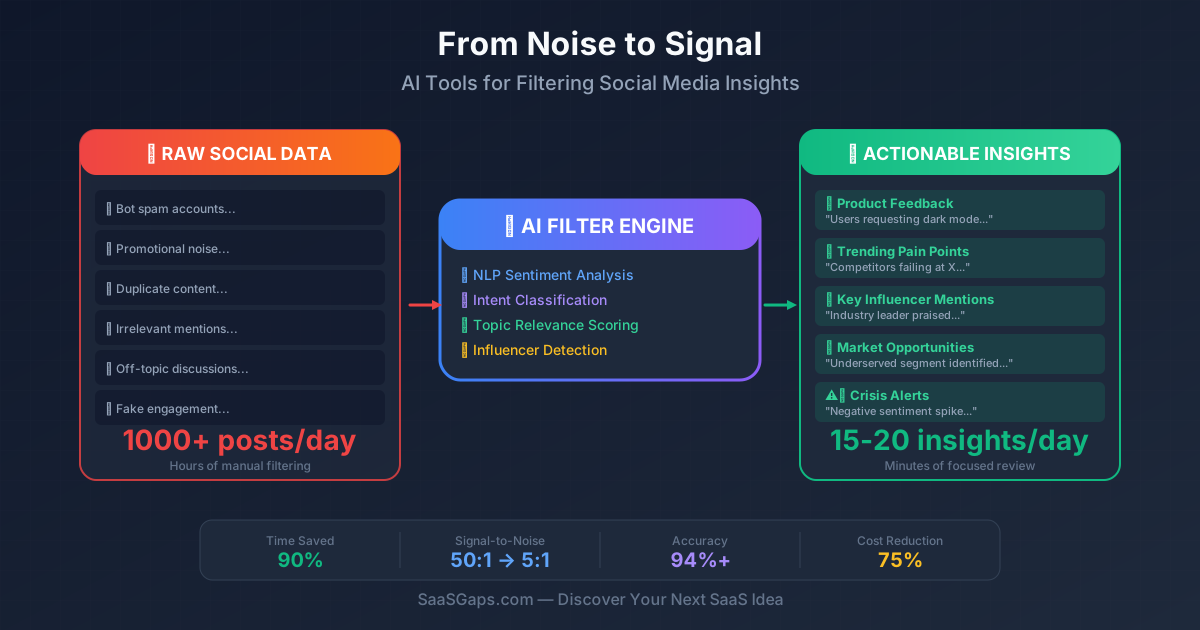
From Noise to Signal: AI Tools for Filtering Social Media Insights
Drowning in social media data? AI filters like Xeet.ai are turning hours of sifting into minutes of clarity. Here's how to implement them.
Tutorial: How to Migrate Your Spotify Playlists to Apple Music, Tidal, or YouTube Music
Ditching Spotify? Learn how to transfer your music library and playlists to Apple Music, Tidal, or YouTube Music using the best migration tools in 2025.

Micro-SaaS Opportunities in Social Media: Solving Pain Points from LinkedIn to X
Real user complaints across LinkedIn and X (Twitter): connection limits, InMail tracking, thread writing, analytics, and bookmark chaos—plus micro-SaaS MVP ideas.
Newsletter
Join the community
Subscribe to our newsletter for the latest news and updates