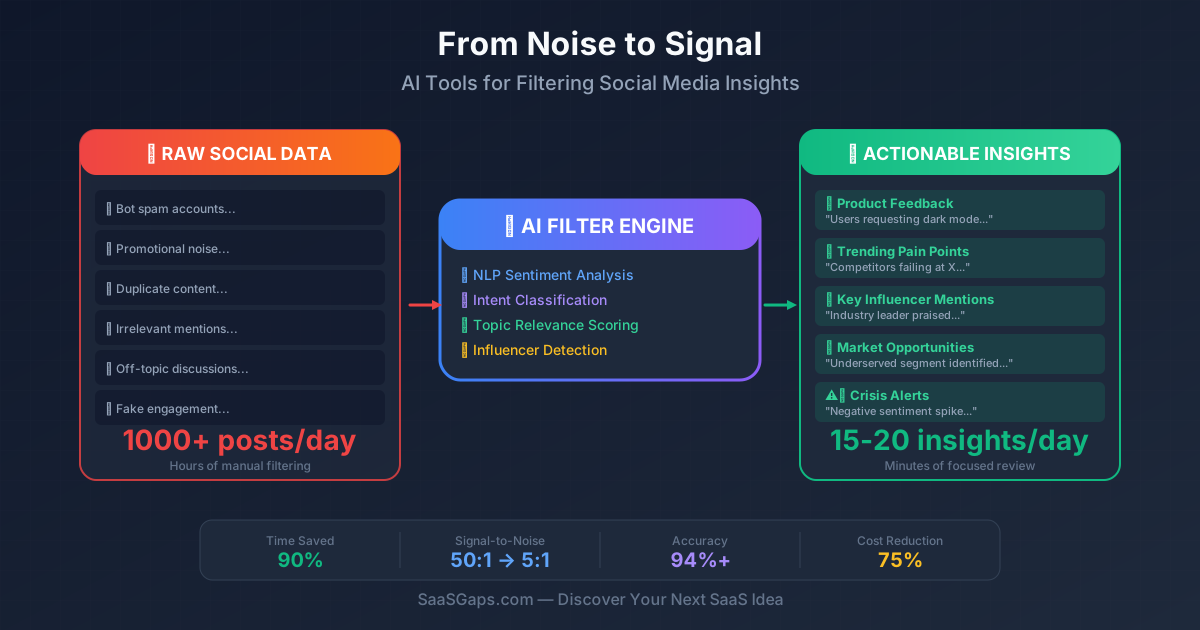
From Noise to Signal: AI Tools for Filtering Social Media Insights
Drowning in social media data? AI filters like Xeet.ai are turning hours of sifting into minutes of clarity. Here's how to implement them.
Social media managers face an impossible math problem every single day. The average brand gets mentioned hundreds or thousands of times across platforms, but maybe 2-3% of those mentions actually matter. The rest? Spam, bots, off-topic noise, and irrelevant chatter that drowns out the signal you desperately need to find.

I've spent considerable time analyzing how teams actually use social listening tools, and the pattern is consistent. Without AI filtering, a social media manager might spend 3-4 hours daily just triaging mentions. With proper AI filters in place, that drops to 20-30 minutes of reviewing pre-qualified, high-value insights. The productivity gain is real and measurable.
The tools have evolved dramatically in the past 18 months. What used to require expensive enterprise software and dedicated analysts is now accessible to small teams and even solo marketers. Let me walk through what's actually working in late 2024 and how to implement these systems without breaking your budget.
The Signal-to-Noise Problem Is Getting Worse
Here's something that doesn't get talked about enough. The volume of social media content is growing faster than our ability to process it manually. Twitter alone sees 500+ million tweets daily. LinkedIn has 2 billion interactions weekly. Instagram, TikTok, Reddit, Discord—the firehose keeps expanding.
Simultaneously, the quality of that content is declining. AI-generated posts are flooding every platform. Bot networks are more sophisticated than ever. Engagement farming and rage-bait content dominates algorithmic feeds. For anyone trying to extract genuine customer insights or market intelligence from this chaos, the challenge has never been harder.
Traditional keyword monitoring doesn't cut it anymore. Setting up alerts for your brand name or product terms returns a tsunami of irrelevant results. You need intelligent filtering that understands context, intent, and relevance—not just string matching.

This is exactly why AI-powered social listening has seen explosive growth. Google Trends shows "social listening AI" searches up 200% year-over-year, with tools like Brand24 seeing 160% growth in search interest. The market is responding to genuine pain.
How Modern AI Filters Actually Work
The technology behind social media filtering has matured significantly. Modern tools combine multiple AI capabilities to transform raw social data into actionable intelligence. Understanding how these systems work helps you evaluate tools and set realistic expectations.
Natural Language Processing forms the foundation. NLP models parse social posts to understand meaning, not just keywords. They can distinguish between "I love this product" and "I would love if this product actually worked"—same keywords, opposite sentiment. Advanced NLP handles sarcasm, slang, emoji context, and platform-specific language patterns that trip up simpler systems.
Sentiment analysis classifies posts as positive, negative, or neutral, but good implementations go deeper. They identify emotional intensity, detect frustration versus anger versus disappointment, and flag urgency signals that indicate a customer might churn or a PR crisis might be brewing. The best tools achieve 92-97% accuracy on sentiment classification, which is impressive given how messy social language can be.
Intent classification adds another layer. A mention of your brand could be a purchase intent signal, a support request, a complaint, a compliment, or just casual conversation. AI models trained on millions of social interactions can automatically route mentions to the right team or bucket. Support issues go to support. Sales signals go to sales. General mentions get logged but don't trigger alerts.
Topic modeling and entity extraction help organize the chaos. These systems automatically identify what subjects people are discussing, what products or features they're mentioning, and what competitive comparisons they're making. Instead of reading 1000 mentions, you get a summary showing "47% of mentions this week discussed pricing, up from 32% last week."
Bot and spam detection has become essential. Studies suggest 5-15% of social media activity comes from automated accounts, and that percentage spikes around certain topics and events. Good AI filters identify and exclude bot activity, preventing your insights from being polluted by fake engagement.
Tools That Actually Deliver
The social listening market has dozens of players, but a handful consistently rise to the top when you filter for AI capabilities and practical usability. Here's what I've seen work well across different use cases and budgets.

Brand24 has emerged as a strong choice for small-to-medium businesses. Their AI-powered sentiment analysis works reliably across English and major European languages. The anomaly detection system alerts you when mention volume or sentiment shifts unexpectedly—useful for catching emerging issues before they become crises. Pricing starts at $79 monthly, which puts it within reach for most marketing teams. The 160% search growth I mentioned earlier reflects genuine adoption, not just curiosity.
Mention targets a similar market but takes a slightly different approach. Their Boolean search capabilities give power users precise control over what gets captured, while AI layers handle the classification and prioritization. The influencer scoring feature automatically identifies which mentions come from accounts with significant reach, helping you prioritize responses. Plans start at $41 monthly for basic needs.
For teams that need both publishing and listening in one platform, Sprout Social has invested heavily in AI capabilities. Their Smart Inbox uses machine learning to surface urgent items and filter noise. The AI Assist feature helps draft responses to common queries. It's expensive at $249+ monthly per seat, but for agencies and larger teams, consolidation reduces context-switching costs.
Hootsuite remains a major player despite feeling somewhat legacy compared to newer tools. Their OwlyWriter AI handles content creation, and their listening streams can be filtered with basic AI sentiment. It's not the most sophisticated AI implementation, but the platform's reliability and integration ecosystem keeps it relevant.
Brandwatch occupies the enterprise tier. Their Iris AI goes beyond basic sentiment to provide consumer research-grade insights. Image recognition identifies brand logos in photos. Trend prediction models forecast where conversations are heading. You'll pay significantly more—pricing is custom and typically runs into thousands monthly—but for brands that need deep market intelligence, the capability gap is real.
Newer entrants like Xeet.ai focus specifically on X/Twitter data with AI-native approaches. These specialized tools often outperform generalist platforms on their target channels because they can optimize for platform-specific patterns.
Implementing AI Filters Without the Learning Curve
Getting value from AI social listening doesn't require a PhD in machine learning. Most tools have simplified setup to the point where a marketing generalist can be running within hours. That said, a few practices separate teams that get real value from those that just collect expensive dashboards.
Start with clear objectives before touching any tool. What decisions will this data inform? If you're trying to identify product feedback, you need different filtering than if you're monitoring brand reputation or tracking competitors. The AI works better when you can tell it what matters—broad "monitor everything" setups return broad, unfocused results.
Define your signal criteria explicitly. What makes a mention high-value versus noise? For some businesses, any mention from an account with 10K+ followers is signal. For others, only mentions expressing purchase intent or frustration qualify. Work this out before configuring filters, then translate it into the tool's classification and alerting rules.
Set up sentiment baselines during a quiet period. AI sentiment analysis is most useful for detecting changes, not absolute levels. If your baseline shows 60% positive / 30% neutral / 10% negative, you'll notice when negative suddenly spikes to 25%. Without that baseline, you won't know what "normal" looks like.
Create escalation paths for different insight types. An angry customer with 50 followers probably needs a support response within 24 hours. An influential journalist asking questions might need executive attention within the hour. Map these scenarios in advance and configure alerts accordingly.
Review AI classifications weekly, at least initially. The models are good but not perfect. Spot-checking their work helps you identify systematic errors—maybe your brand name is a common word in another context, causing irrelevant matches. Most tools let you provide feedback that improves classification over time.
The X/Twitter Filtering Challenge
Twitter—now X—presents unique filtering challenges that deserve specific attention. The platform's real-time nature, reply threading, quote tweets, and engagement farming tactics create noise patterns different from other networks.
A viral tweet mentioning your brand might generate thousands of replies and quote tweets. Most of those are people responding to each other, not expressing original opinions about your brand. Naive monitoring counts all of these as "mentions" and wildly overstates your actual exposure. Good AI filters de-duplicate threaded conversations and weight original posts higher than derivative engagement.
The recent changes to X's API have complicated third-party access. Pricing went up dramatically, and rate limits became more restrictive. Some tools have passed those costs to customers; others have reduced X coverage. When evaluating tools, specifically ask about their X data access and any recent changes.
Bot activity on X remains significant despite platform efforts. During news events, product launches, or controversial moments, bot networks amplify certain narratives. AI filters trained on bot detection patterns help ensure your insights reflect actual human sentiment, not coordinated inauthentic behavior.
The platform's shift toward long-form content, subscriber-only posts, and video changes what's even available to monitor. Some high-value conversations now happen in spaces that third-party tools can't access. Factor this into your expectations about coverage completeness.
Building Custom Filters for Specific Use Cases
While off-the-shelf tools handle most needs, some teams benefit from custom filtering layers. This is more technical but can provide significant advantages for specific applications.
Competitor intelligence gathering often requires custom approaches. You want to capture mentions of competitor products, complaints about their service, and comparisons to your offering—but not general news coverage or their own marketing. Custom classifiers trained on your specific competitive landscape outperform generic sentiment models.
Product feedback extraction works better with domain-specific NLP. If you're a fintech company, generic sentiment models might misclassify discussions about "interest rates" or "credit limits" as negative when they're actually neutral explanations. Custom models trained on your product vocabulary and customer language patterns improve accuracy.
Crisis detection requires tuned thresholds. What constitutes an anomaly varies dramatically by brand. A 50% spike in mentions might be normal during your product launch but alarming on a random Tuesday. Custom alerting logic that accounts for expected patterns reduces false alarms while catching genuine issues.
The technical barrier for custom implementations has dropped significantly. OpenAI and Anthropic APIs let you build sophisticated classification systems without training models from scratch. Feed examples of the classifications you want, and the models generalize reasonably well. Tools like n8n and Zapier can orchestrate these AI calls alongside social monitoring data.
Measuring ROI on AI Filtering
Justifying the cost of AI social listening tools requires connecting them to business outcomes. Time savings provide the most straightforward calculation, but deeper impacts often matter more.
Track response time to customer issues before and after implementation. If your team previously took 8 hours average to notice and respond to social complaints, and AI filtering cuts that to 2 hours, you can quantify the customer experience improvement. Faster response correlates with higher customer satisfaction and reduced churn.
Measure insight-to-action conversion. How many product changes, marketing adjustments, or strategic decisions traced back to social insights? Tools that surface actionable intelligence—not just dashboards—demonstrate value through the decisions they inform.
Calculate the opportunity cost of missed signals. Before AI filtering, your team almost certainly missed important mentions buried in noise. Estimate the value of catching competitive intelligence, influencer opportunities, or crisis signals that previously went unnoticed.
Compare against the alternative of hiring. A dedicated social listening analyst costs $50-80K annually in salary alone, plus benefits, training, and management overhead. AI tools that deliver equivalent intelligence for $1-3K annually represent significant savings, even accounting for the team time still required to act on insights.
Where This Is Heading
The AI filtering capabilities available today will look basic within two years. Several developments are already visible on the horizon.
Multimodal analysis is expanding rapidly. Current tools primarily analyze text, but social media is increasingly visual and video-first. AI systems that can analyze images, video content, and audio from social platforms will capture insights that text-only tools miss. Early implementations already exist in enterprise tools like Brandwatch; expect broader availability soon.
Predictive analytics will move from experimental to practical. Instead of just telling you what people are saying now, AI systems will forecast where sentiment is heading, which issues are likely to escalate, and what topics are emerging before they peak. The models for this exist; the challenge is packaging them accessibly.
Generative AI integration is obvious. Instead of just filtering and classifying, AI tools will draft responses, create report summaries, and suggest actions. Some tools already offer basic response suggestions; expect much more sophisticated assistance as LLM capabilities advance.
Cross-platform identity resolution will improve. Currently, tracking the same customer across X, LinkedIn, Reddit, and other platforms requires manual effort. AI systems that can probabilistically link identities will enable true omnichannel customer understanding.
The competitive dynamic will intensify. As these capabilities become table stakes, differentiation will shift to data access, industry-specific training, and integration depth. Smaller players may consolidate or disappear; platform-native tools may absorb third-party functionality.
Getting Started This Week
If you're currently drowning in social media noise without AI assistance, here's a practical starting path.
Sign up for free trials of Brand24 and Mention. Both offer enough trial access to evaluate their AI filtering on your actual brand data. Set up identical keyword tracking on both and compare the quality of their sentiment and relevance classification over a week.
Configure one high-priority alert. Pick your most important signal type—maybe negative mentions from high-follower accounts, or any mention of your main competitor. Get that single alert working reliably before expanding scope.
Audit your current social listening workflow. Document how much time your team currently spends on social monitoring. This gives you a baseline to measure improvement against and helps justify tool investment to stakeholders.
Consider whether AI filtering is the core problem. Sometimes the issue isn't filtering—it's that nobody is acting on the insights regardless of quality. Ensure you have clear ownership for responding to what the AI surfaces before investing heavily in better detection.
This intelligence challenge is exactly what motivated building SaaSGaps. We apply AI filtering to identify validated SaaS opportunities from social media conversations—finding the signal of genuine user pain points among the noise of millions of posts. Every week, we deliver curated opportunities with clear evidence of demand, saving founders the research work of finding what to build next.
Subscribe to get weekly validated SaaS ideas →
The social media noise problem will only intensify as platforms grow and AI-generated content floods every feed. Teams that implement AI filtering now build capabilities that compound over time—better baselines, tuned classifiers, and established workflows. Those who delay will find the mountain of noise increasingly impossible to summit manually.
Want more validated SaaS ideas delivered weekly? Join the SaaSGaps newsletter and get curated opportunities based on real user pain points.
Author

Categories
More Posts
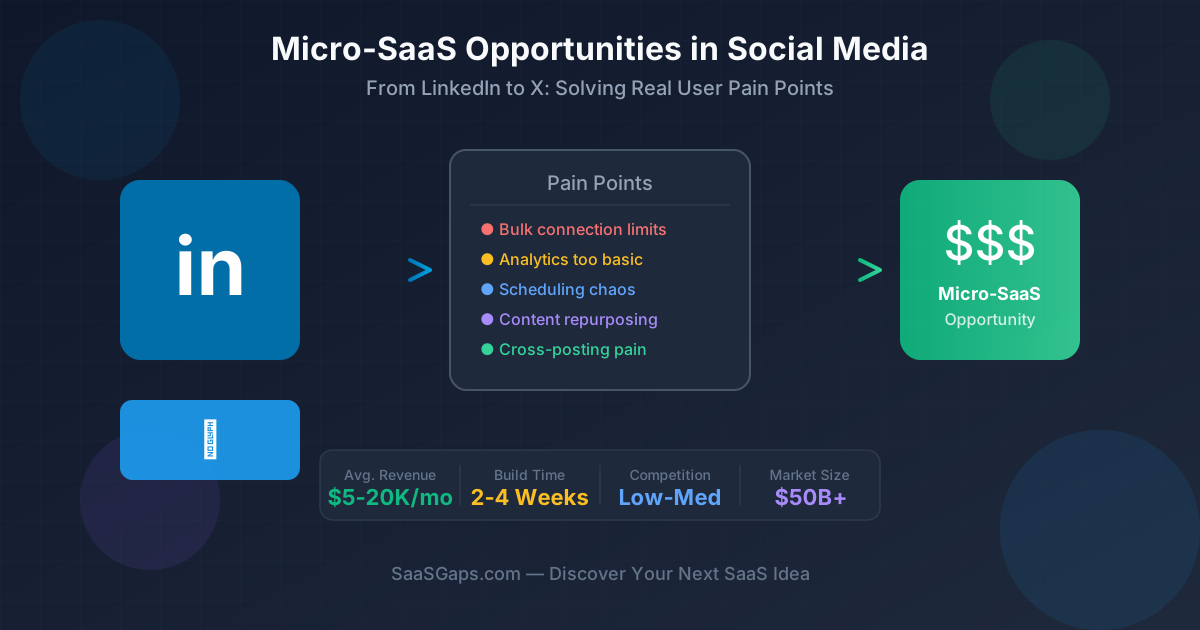
Micro-SaaS Opportunities in Social Media: Solving Pain Points from LinkedIn to X
Real user complaints across LinkedIn and X (Twitter): connection limits, InMail tracking, thread writing, analytics, and bookmark chaos—plus micro-SaaS MVP ideas.
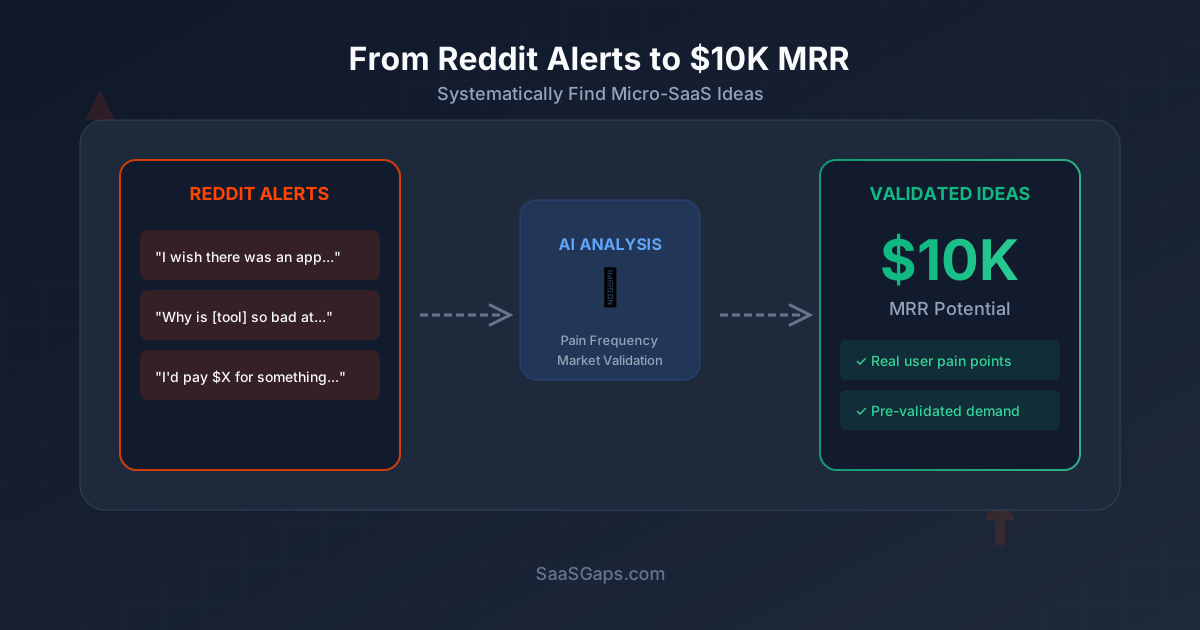
Reddit Alerts: Set Up Keyword Alerts to Find Micro-SaaS Ideas
Set up Reddit keyword alerts (F5Bot/RSS), track "I wish there was an app that..." posts, and turn recurring pain points into validated micro-SaaS ideas.

Step-by-Step: Add Stripe Checkout to Your Next.js App for SaaS Monetization
Monetize your SaaS fast! This guide shows you how to integrate Stripe Checkout into your Next.js app with code examples and best practices.
Newsletter
Join the community
Subscribe to our newsletter for the latest news and updates