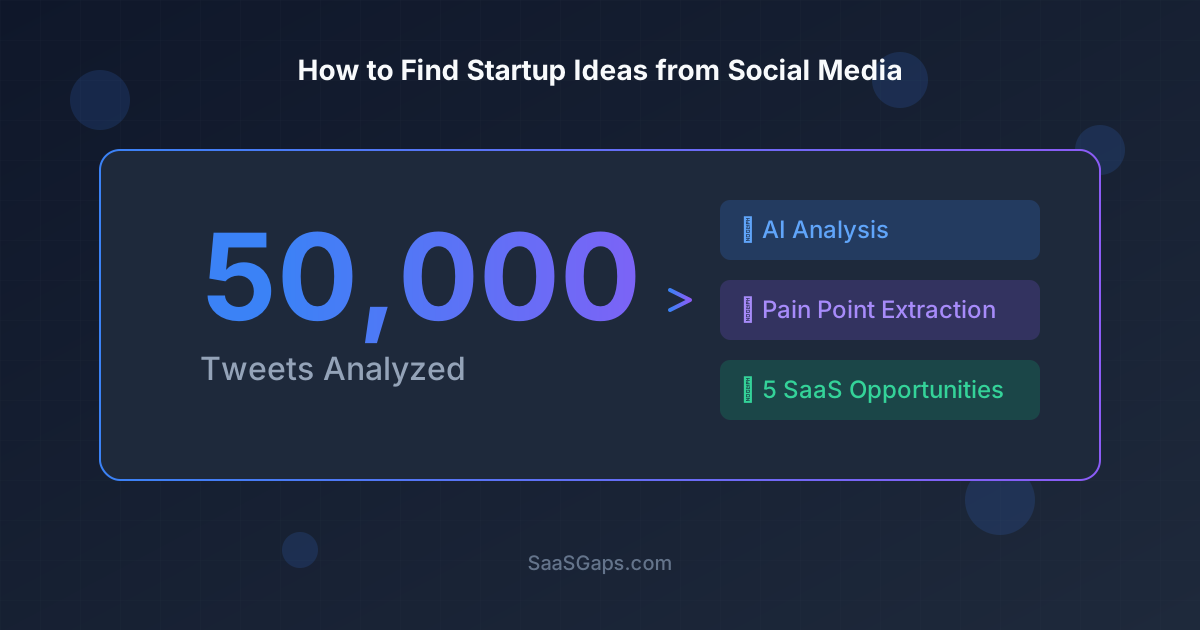
How I Monitored 50,000 Tweets and Discovered 5 SaaS Opportunities
A deep dive into using AI to analyze social media complaints and uncover validated micro-SaaS ideas that real users are willing to pay for.
Last month, I ran an experiment that changed how I think about product ideas. Instead of sitting in a coffee shop brainstorming what the world might need, I decided to let real users tell me directly. I built an AI system to monitor 50,000 tweets—specifically hunting for complaints, frustrations, and those golden "I wish there was an app for..." moments.

The experiment yielded five concrete SaaS opportunities. Not vague ideas. Real problems that real people are actively complaining about, with clear signals that they'd pay for solutions.
Let me walk you through what I found.
Why Most Product Ideas Fail Before Launch
Here's something uncomfortable: about 90% of startups fail, and the number one reason isn't running out of money or bad execution. It's "no market need." Founders build something nobody asked for.
The traditional approach goes like this. You think of a cool technology, get excited, spend six months building it, launch to crickets. Sound familiar? I've done it myself. Twice.
But what if we could flip that process entirely? What if instead of guessing what people want, we could actually listen to them complaining about problems in real-time?
That's what social media monitoring enables. Every single day, millions of people publicly broadcast their frustrations. They tag companies. They vent to followers. They beg for someone to solve their problem. The data is just sitting there, waiting to be mined.
The Monitoring System
I built a Chrome extension that intercepts tweets matching frustration patterns. Phrases like "I hate when," "why isn't there," "someone should build," and "I'd pay for" became my filters. The extension also captures angry replies to software companies—those are particularly revealing.

All captured tweets feed into an AI pipeline that extracts the core pain point, categorizes it by market type, and scores its validation potential on a 1-10 scale. After four weeks and 50,000+ tweets, patterns emerged. Here are the five opportunities that scored highest.
The AI PR Quality Auditor
Companies are racing to replace human PR teams with AI automation, and it's creating a new problem. The content coming out is often embarrassingly bad—robotic tone, factual errors, completely missing the brand voice.
I found dozens of marketing professionals cringing publicly about this. One particularly memorable tweet: "Just received a 'personalized' PR pitch that mentioned our competitor's product name three times. AI PR tools need serious quality control."
The opportunity here is a quality gate. A tool that sits between AI content generation and publication, checking for brand voice consistency, factual accuracy, competitor mentions, and overall professionalism. PR agencies are adopting AI tools to cut costs, but they're terrified of reputational damage. That fear is monetizable.
The pricing model practically writes itself. Agency plans at $99-299 per seat monthly, with enterprise tiers for large brands who can't afford public embarrassment.
The Leadership Task Delegation Assistant
This one surprised me with its frequency. Managers and founders kept complaining about the same thing: they love leading teams and setting strategy, but the administrative overhead is killing them.
One founder summed it up perfectly: "I became a CEO to build products and lead teams, not to spend 3 hours daily on Slack asking 'any updates on that thing?'"
The insight is that existing project management tools still require active management. Notion, Asana, Linear—they're all just databases that humans have to maintain. What if a tool could flip that model? Instead of the manager managing the tool, the tool manages the manager.
Imagine automatic follow-ups on assigned tasks, status reports generated from team communication patterns, flagging of blocked or overdue items, even suggesting who should own new tasks based on current workload. Integration with the tools teams already use—Slack, Notion, Linear—would be essential.
Small teams might pay $49 monthly. Department-level pricing could hit $199.
The Human-Centric Route Planner
Tesla owners and Google Maps users complain constantly about navigation making what they call "non-human" decisions. The algorithms optimize for raw efficiency but completely ignore local knowledge.
"My Tesla just routed me through the worst intersection in the city to save 30 seconds. Any local knows to avoid that left turn at rush hour." Another user: "Google Maps doesn't understand that 'faster' doesn't mean 'better' when you're driving through a sketchy neighborhood at midnight."
Current navigation apps optimize for a single variable: time. Real humans optimize for multiple things simultaneously—safety, comfort, avoiding frustration, sometimes just enjoying the drive. A route planner that lets users define their own optimization function would tap into genuine unmet demand.
Core features would include avoiding specific intersections, preferring scenic routes on weekends, crowdsourced "local knowledge" data, and customizable "never route me through" zones. Freemium with a $4.99 monthly premium tier seems right for this market.
The Nail Salon Service Finder
This opportunity genuinely surprised me. Multiple frustrated customers couldn't find nail salons offering specific services—especially "regular polish" instead of gel or dip.
"I just want a simple manicure with regular polish. Why is it impossible to find a salon that still does this? Spent an hour calling around."
The deeper pattern is that niche service discovery in local businesses is fundamentally broken. Yelp and Google show you that salons exist, but they don't help you filter by the specific services actually offered. This is a vertical search problem begging for a focused solution.
A discovery platform specifically for nail salons (expandable later to other beauty services) could let users filter by exact service type, see real-time availability, compare prices transparently, and browse stylist portfolios. The business model would be commission-based booking (10-15%) plus premium listing options for salons.
The beauty services market is $63 billion in the US alone. Even capturing a tiny slice would be substantial.
The Next-Gen Link-in-Bio Builder
Linktree dominates the link-in-bio space, but scroll through creator Twitter and you'll find constant complaints. Limited customization. Analytics that aren't actually useful. Slow load times. Pricing that feels exploitative for basic features.
One tweet encapsulated the frustration: "Linktree is charging $24/month for features that should be free. Someone please build a better alternative."
The creator economy is booming, which means Linktree has genuine product-market fit. But product-market fit and customer satisfaction aren't the same thing. If an incumbent gets complacent, that's an opening.
A next-generation competitor would offer full design customization (not just color pickers), built-in email capture, integrated digital product sales, analytics that actually reveal patterns, A/B testing for links, and auto-updating from social platforms. Free tier with branding, $9 monthly for pro users, $29 monthly for a full creator suite.
Patterns That Emerged
After processing all this data, a few things became clear.
B2B opportunities come with deeper pockets. The PR Auditor and Delegation Assistant have cleaner monetization paths because businesses will pay $200 monthly for something that saves 10 hours of work. Consumers agonize over $5 monthly.
Competition validates markets. The Linktree alternative might seem crowded, but that crowding proves demand exists. Lazy incumbents create openings for hungry newcomers.
Not every complaint is an opportunity. The scoring system matters. I evaluated each idea on frequency (how often does this complaint appear?), intensity (how frustrated are they?), willingness to pay (are they asking for a product or just venting?), and solvability (can software actually fix this?).
Doing This Yourself
You don't need to monitor 50,000 tweets manually. A simpler version starts with Twitter/X search alerts for frustration phrases. Spending 30 minutes daily reviewing complaints in your target niche, keeping a spreadsheet of recurring patterns—that's enough to start seeing opportunities.
Tools like Mention, Brand24, or Sprout Social can automate the collection. Set up keyword alerts and review the aggregated complaints weekly.
Or you could skip all that setup entirely. This is exactly why I built SaaSGaps. Every week, we analyze thousands of social media posts and deliver the top validated SaaS opportunities directly to your inbox. No monitoring required. No AI setup needed. Just actionable ideas with real user pain points, ready to build.
Subscribe to get weekly validated SaaS ideas →
The Core Insight
The best SaaS ideas aren't invented in isolation. They're discovered by listening. Real users broadcast their problems publicly every single day. The founder's job is to pay attention, validate what you're hearing, and build solutions that people are already asking for.
These five opportunities came from just one month of monitoring. Imagine what consistent, focused attention on your target market might reveal over time.
Stop guessing. Start listening.
Want more validated SaaS ideas delivered weekly? Join the SaaSGaps newsletter and get curated opportunities based on real user pain points.
Author

Categories
More Posts

Tutorial: How to Migrate Your Spotify Playlists to Apple Music, Tidal, or YouTube Music
Ditching Spotify? Learn how to transfer your music library and playlists to Apple Music, Tidal, or YouTube Music using the best migration tools in 2025.
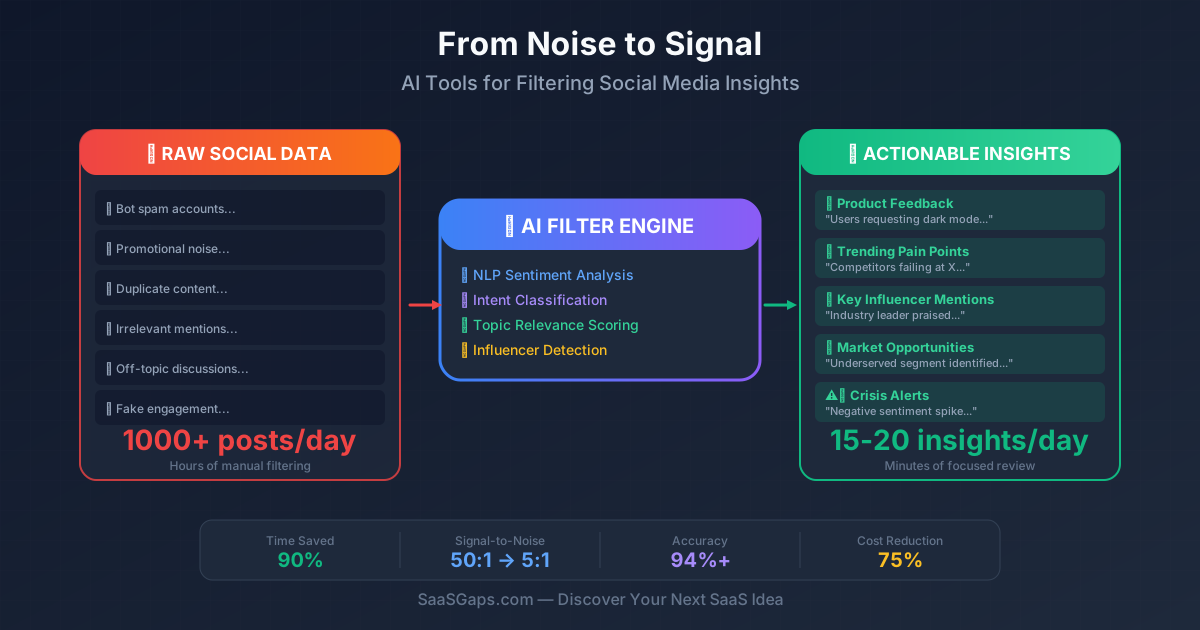
From Noise to Signal: AI Tools for Filtering Social Media Insights
Drowning in social media data? AI filters like Xeet.ai are turning hours of sifting into minutes of clarity. Here's how to implement them.

Idea Mining: The Systematic Approach to Discovering SaaS Opportunities Hidden in Plain Sight
Learn how successful founders systematically discover validated SaaS ideas by mining community discussions, support tickets, and forums for recurring complaints and unmet needs. A complete guide to idea mining methodology.
Newsletter
Join the community
Subscribe to our newsletter for the latest news and updates